04 October 2006

Stop the propaganda: "Free TV" is worth every cent we pay

"Do you want your children to have to pay... or just miss out?" warns Network Ten sports presenter Ryan Phelan, doing his best to put on a "Grim Reaper" voice, his suit buttoned up, and shot from below to make him look more even more serious and worrying.

It's the new campaign by Free TV (what the cabal of free-to-air broadcasters calls itself these days), and it even has its own web presence under the title Save My Sport. It's a cynical attempt to fend off new "Use it or lose it" legislation that would force free-to-air broadcasters to actually screen the sports (and other events) to which they buy rights... or else lose them.

"Save My Sport"? I say "Save Your Breath"!

"Last year," the campaign media release tells us, "Australian sports fans watched over 1648 hours of sport on free TV." What the release and the TVC conveniently ignore is the thousands upon thousands of hours of programming - including major sports and superbly-crafted, Emmy-winning fare treasured elsewhere in the world - that "Free TV" has rationed, buried, dumped, butchered and otherwise treated with utter contempt... and we, the viewers, with it.

Have you (like me) found yourself staying up till the early hours of Monday morning to watch first-run episodes of The Office (US version), winner of this year's Emmy for Best Comedy, wedged embarrassingly by Network Ten between ads for ringtones and mobile phone p*rn?

The litany of insults to the audience (and program makers) could run for pages (and often does in the Letters section of the Green Guide). Quality programming dumped after two weeks or banished to late night. Ground-breaking shows screened (first-run) at 4 am. Episodes of series with long story arcs screened out of order. Promos that contain "spoilers" (i.e. giving away key plot twists). Cutting PG-rated episodes of "The Simpsons" so they qualify for G classification, just so they could be promoted (not screened) in kids' viewing times.

And then there's the dissembling. "That was the last program in the current series of The West Wing (or The Sopranos, etc. etc.)," says veteran GTV9 voice-over man Pete Smith. "No it's not," we yell back at the TV - we've looked up the episode guide online or seen the DVD boxed set that's already available at JB Hi-Fi. Poor old Pete must feel like former Iraqi Information Minister Mohammed Saeed al-Sahhaf: we know it's a lie, they know it's a lie, but the networks just don't care.

So WHY don't they care, especially when these sort of practices have been exposed and criticised for years? It all comes down to one thing: as viewers of free-to-air television, we are NOT CUSTOMERS. In fact, to the folks at "Free TV", we aren't even complete human beings.

We are merely fingers on remote controls, bums on seats, eyeballs, or TARPS (target audience ratings points), to be harvested and offered up to the people they regard as their REAL customers - the advertisers. In terms of an industry value-chain model, we don't even qualify as "suppliers" to Free TV - we're actually more like raw material, to be extracted, processed, sorted, bundled up and handed over to the media buyers. So what if there's a bit of wastage along the way? That's just the cost of doing business!

The only time Free TV broadcasters acknowledge that there is value in an actual human response to what's on air is when they can see an opportunity to capture that value using a revenue-positive telephone voting scheme (Idol, Dancing With The Stars, etc).

When I pay for a service, I have a contractual relationship with the provider. Usually, it matters to service providers that I perceive value in the relationship and they care about my satisfaction. And if the provider misleads me, lies to me or fails to deliver what I have been promised, I can complain and get my money back, plus I have protection under a variety of laws.

But I have no contract with Channels Seven, Nine, or Ten. I have no customer number, no viewer profile, no CRM file, because I have no relationship. Hence, in the current culture of the networks, concepts like customer value and satisfaction are not only unheard of but completely irrelevant.

As Australian Pay TV continues to recruit new paying customers who perceive it as offering value (choice, timeshifted programs, commercial-free movies, personal digital recording TiVo-style, etc.), free-to-air broadcasters have got the wrong end of the stick. They are trying to hang on to the privileged position that once allowed them to succeed despite treating viewers like dirt. But the days when - as Kerry Packer famously said - a TV broadcasting licence was "a licence to print money" are over.

Free TV will only succeed in the future if free-to-air broadcasters start acknowledging TV viewers not only as valued customers but also as partners in the process of creating and delivering value to advertisers and shareholders.

It's simple: those who deliver superior customer value win. Hey Eddie, Kerry and John - that's how a "free" market works!

03 October 2006

Can you be "ambushed" by a blimp?


Oh, the humanity!

Looking at the fuss in the media, you could be forgiven for thinking that the Holden Airship had collided with one of the MCG light towers and collapsed in flames onto the hallowed turf during the Toyota AFL Grand Final. But by simply hovering in the general vicinity of Jolimont, the General's blimp has cast a giant shadow - figuratively and literally - over current sponsorship practices.

Numerous commentators are having a field day, even invoking the current chestnut of "Australian values": according to Crikey.com.au, Peter Young of Cricket Australia says it was "just un-Australian (for Holden) to try and sneak a free ride off the back of someone else's work".

But then perhaps Toyota ought to know a free ride when it sees one. Only five years ago Toyota itself employed controversial tactics against Holden that were seen at the time as "ambush marketing", in a campaign I’m sure no-one at Holden has forgotten.

Champion golfer (and sometime pasta sauce maker!) Greg Norman was paid by Holden to endorse its Statesman luxury sedan range for several years but, in 2001, switched allegiance to the Toyota Avalon for a sum reckoned to be $10 million (as reported on Drive.com.au at the time). The TV advertisement that launched Norman’s involvement with Toyota featured a weekend hacker so over-awed by Norman’s arrival at the tee that he duffs his drive into the car park, smashing the window of a Holden Statesman. He apologises profusely to Norman, who reassures the wayward swinger that the Statesman is not his – "Mine’s the Toyota".

Holden certainly objected at the time, both publicly and directly (by letter) to Toyota. Comparisons were drawn with the famous Mortein vs Raid case that centred on John Laws' switch from one fly spray brand to another. Noises were made about the potential for Holden to sue Toyota for misleading and deceptive conduct under s52 of the Trade Practices Act, but (to my knowledge) it never made it anywhere near the Federal Court. Unlikely, anyway, as (in contrast to Mortein v Raid) the distinction between the two brands was made fairly explicit in the TVC, leaving little risk that consumers might be confused as to Norman's new allegiance or perceive any connection between Statesman and Toyota.

Anyway, I haven't yet seen any actual cries of "no fair" from Toyota about the Airship ambush, and any loud public expression of concern is, in my opinion, highly unlikely. Don't get me wrong - I am vehemently opposed to free riding in any form. But while the blimp may well have been sailing close to the wind, a strident complaint from Toyota could easily be seen as the pot calling the kettle black... and how un-Australian would that be?!

14 September 2006

Pauline Hanson endorses the Donut King brand... Please explain?!


My lecture on "leveraging secondary brand assoc- iations" (by linking a brand to an entity like a celebrity, a country of origin, another brand, etc.) was still fresh in my mind the other night as I relaxed in front of the TV. Totally without warning, former One Nation leader and ex-con Pauline Hanson - one of the most divisive figures in recent Australian cultural history - appeared in the middle of an ad for Donut King, asking me something along the lines of "What do you feel like?".

Well, I'm happy to say that I felt like a fool - what would my students think? What would they ask me in next week's class if they'd seen this bizarre campaign? Surely all that stuff I'd been saying about marketers choosing celebrity endorsers for the beneficial secondary associations they bring to the brand must be complete rubbish?!

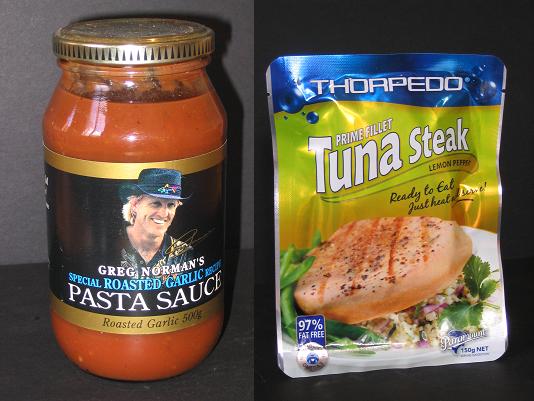
At first, I thought that I would have to explain it away as just another clearly bad choice - like (pictured) Ian Thorpe's THORPEDO tuna steaks or Greg Norman's pasta source (well Paul Newman did it... Greg Norman is near enough, isn't he?). And there are plenty of examples of using a celebrity - especially a notorious one like Mark "Chopper" Read - simply to get attention.

But then I started to wonder...

What if Donut King actually does want to tap into the network of brand associations that we hold (or some of us hold) about Pauline Hanson? Which of those associations could they possibly regard as potentially beneficial to the Donut King brand?

At a rational, brand performance level, there's nothing to go on - Pauline is vaguely known as a former fish and chip shop owner, but not a renowned expert on donuts whose endorsement would matter to us: Wow, she really knows donuts, so for her to put her name to those Donut Kings really means something! No, I think not. Homer Simpson comes to mind more readily (and would probably be a better electoral bet than Pauline these days, too).

It can't be about user imagery, surely? For how many Australians does Pauline Hanson have aspirational appeal? She's not exactly renowned for her good taste, so I consider it doubtful that there's anyone who would feel better eating a Donut King donut now that they know it's Pauline's choice.

So it must be more to do with linking to emotions, attitudes and perhaps even values that we associate with Pauline Hanson... and that, of course, is very dangerous territory. Perhaps it's an attempt to position the gaudy pink donut - iced with "hundreds and thousands" - firmly in the 1950s version of Australian cultural life that Ms Hanson seems to favour, alongside fairy bread at a kids' party, an Iced Vo-Vo biscuit, Bob Menzies in Canberra and the "yellow peril" still a few thousand miles to the north. Multiculturalism? Why, we've got all the diversity you'll ever need right here at the donut counter!

(By the way, donuts and multiculturalism are not mutually exclusive - I often enjoy an Italian style bomboloni with apricot jam filling from Caffe di Lusso in Glenferrie Road, Hawthorn.)

Another thought: maybe it's about protecting Australian interests against foreign takeovers of our markets. With business travellers still queuing to buy boxes of Krispy Kreme doughnuts at Sydney Airport, Melbourne's first KK store located at Fountain Gate (right in "Kath & Kim" territory), and KK's fund-raising program earning them tremendous kudos with community organisations, maybe Donut King is trying to send out a subtle call to patriotism (or xenophobia) by linking themselves to such a prominent anti-immigration, "White Australia" campaigner?

Or maybe I'm missing something more obvious. Perhaps, as a prominent Royalist, it's logical that Ms Hanson would support anything with "King" in the title: stand by for Pauline as spokesmodel for Burger King or King Oscar Sardines.

Better still, there's one product endorsement opportunity that would neatly combine her racist attitudes with support for royalty and good old fashioned Australian values: White King bleach.

06 September 2006

Tick infestation is bad for the heart


The National Heart Foundation announced a couple of weeks ago that it would be extending its "Tick program" to "everyday eating out of the home", including restaurants and food courts.

In effect, this move constitutes an extension of the Tick brand into a new category. But it comes at a time when the brand has never been more under threat, and when (I would argue) attention should be focused on brand protection rather than extension.

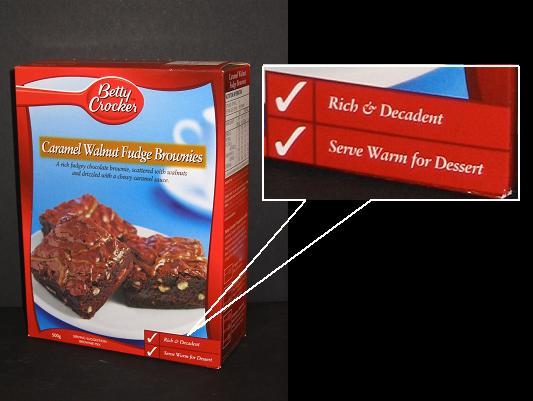
Ticks are taking over the supermarket shelves. Over recent years a tick (and very often a white tick on a red background) has come to denote first any nutritional claim ("97% fat free"), then any functional claim ("baked not fried"), and now any claim at all (just look at the picture above)! I picked up a box of Betty Crocker Brownie Mix in a supermarket last week, having noticed the white ticks on red - a familiar cue that I have come to associate with at least some level of nutritional information or endorsement. I (honestly) assumed that Betty Crocker was making some health claim - low fat, low GI, high fibre, etc. But no! Apparently, in this age of "premiumisation", when it's OK to be indulgent, even a claim of being "Rich and decadent" deserves a tick! Even Coles has commandeered the tick as the central feature of its new master housebrand "You'll love".

Don't get me wrong: there's absolutely no doubt in my mind that the Heart Foundation has built brand equity in the Tick. In fact, I'm sure that many consumers have come to rely on the Tick - just ask the copycats why they have plastered ticks all over their packaging. Even those who pay to use the official Heart Foundation Tick often stretch the friendship - Parmalat, owner of the Rev brand of low-fat milk, uses two smaller ticks right alongside the Tick to denote a claim of being a "rich source of Calcium (and) Protein".

The Heart Foundation clearly understands what the Tick is supposed to do: "Consumers rely on the Heart Foundation Tick to help them to make healthier food choices quickly and easily (my emphasis)", as they say on their website. They want us to trust the endorsement and respond to the Tick on the basis that we believe that "All Tick approved products represent a healthier choice".

Research might well show that consumers are - rationally - aware of the Tick and the "Pick The Tick" campaign, and even of the underlying objectives of the program. But we are talking here about frequent, highly routine purchases in a supermarket context. Studies of consumer behaviour in supermarkets have found average shopping times of less than 12 seconds per item, including the time taken to walk down an aisle and approach the display. Under these conditions, recognition of salient brand cues - basic colours, shapes, symbols, colour schemes and product Gestalt - is critical.

Consumers expect that these brand cues will make decision-making easier by acting as a kind of shorthand, not only for manufacturer or origin, but also for intangible associations like the trust that comes from third-party endorsement.

Faced with evidence of growing consumer confusion, the Heart Foundation has been encouraging us to make more of an effort to ensure that we are picking up the RIGHT tick. Unfortunately, once you have to tell consumers to trust SOME ticks but not others, you completely undermine their confidence and destroy the value of the Tick as a symbol: decision-making becomes more difficult and the perceived risk (of making the wrong choice) is higher.

On any critical appraisal, the Heart Foundation has failed to protect its intellectual property and it continues to suffer from very significant "leakage" of its marketing investment. Part of this stems from a poor choice of vehicle for this investment in the first place. The 1988 Trade Mark registrations for what is described as a "Correct symbol, in disc, in circle" note explicitly that "Registration gives no right to the exclusive use of the device of a TICK (CORRECT SYMBOL)". In other words, it has been known for nearly 20 years that a "tick" was too generic a choice - the Foundation can't "own" a symbol that is used so widely and non-specifically.

Secondly (and strangely, given the endorsement on the registration), it seems the Heart Foundation took a long time to recognise that it had a problem with copycat ticks. It should not have come as a surprise that other marketers would seek to exploit and leverage brand equity any way they could. But it appears that the Foundation made no regulatory attempts to stop others appropriating equity in the Tick until 1997 - that's when it lodged a Trade Mark application for a white tick on a disc of solid colour but without the words "National Heart Foundation Approved" around it. This application was rejected pretty swiftly.

The Foundation should act now - and quickly, before others like Betty Crocker completely undermine consumer brand knowledge and hence completely devalue the program - to shore up its equity in its brand elements, and plug the leaks. There are many conceivable ways to create a modified branding device that is simple, distinctive, meaningful and (above all) protectable, yet builds on what equity remains in the Tick. I'd love to hear from the Heart Foundation if they are interested...

28 August 2006

Attention Cummins: Don't hold others back... Resign the Connex account now!


OPEN ON MCU OF A GROUP OF ADVERTISING STRATEGY PLANNERS AND CREATIVES FROM SEVERAL DIFFERENT MELBOURNE AGENCIES. THEY ARE OBVIOUSLY TALENTED AND CAPABLE OF DOING GREAT WORK. CARRYING PORTFOLIOS AND STORYBOARDS, THEY ARE TRYING TO ENTER THE OFFICES OF MELBOURNE TRAIN OPERATOR CONNEX.

MUSIC FADES UP: OBSCURE TRANSYLVANIAN FUNERAL LAMENT.

CAMERA PULLS BACK TO REVEAL THAT THE TALENTED GROUP IS BEING RESTRAINED BY ANOTHER GROUP. SELF-INDULGENT CREATIVES FROM CUMMINS AND PARTNERS, THIS SECOND GROUP IS DESPERATELY GRABBING AT THE ANKLES OF THE FIRST.

ORDINARY VICTORIAN COMMUTERS LOOK ON, TOTALLY PERPLEXED.

Connex launched its Don't hold others back ad campaign on 13 August. According to the Connex press release, "the centrepiece of the campaign are (sic) TV ads that can only be described as intriguing".

Only as intriguing?!! You're kidding, right? From my first viewing of the campaign, I'm afraid numerous other adjectives came to mind!

This is a campaign designed to tell commuters that it's their fault Connex trains don't run on time more often. If you decide this is the right thing to be telling commuters (and I'm not at all certain that it is), it sets up a communications challenge that calls for brutal honesty and self-reflection on the part of the advertiser. You have to be prepared to disarm commuters' natural counter-arguments first - by acknowledging your own shortcomings - before you can begin to hope for a fair hearing. And your message needs to be delivered with a very high degree of empathy and, probably, ironic humour.

Cummins & Partners' creative strategy fails on both counts. The choice of black & white cinematography, the funereal music and the images themselves evoke Stalinist Russia - they are cold and there is not a jot of empathy. Then the message "tag" is delivered not by a human being, or even a human voice, but by a sign on the end of the platform - a piece of totalitarian bureaucracy worthy of Orwell's "thought police". There's no light at the end of the tunnel: the depiction of the problem is dark and heavy-handed, but the solution is just a sign telling us how we should think and behave.

Let's face it, we're not talking here about HIV/AIDS in the 1980s. A campaign to encourage commuters to contribute to the shared goal of helping the trains run on time doesn't exactly call for the Grim Reaper.

20 August 2006

Spoilt for choice? (Or spoiled by choice?)

As discussed with Helen Razer on ABC Victoria local radio, Sunday 20 August

It's been your favourite chocolate bar for as long as you can remember. But suddenly it comes in King Size, Bite-sized, Chunky, "Bits", peanut butter-filled, white chocolate, dark chocolate, low GI and guarana-boosted varieties.

Or your current toothbrush is looking shaggy and needs replacing. You spend 5 minutes in front of the oral care shelves of the supermarket - it's only 3 months since you bought your last brush, but the range of product features has changed even in that short time. Suddenly you're worried about something you weren't even aware of when you walked in: Do I need whitening, tartar control, plaque removal, gum massage, and a tongue scraper? And in what combination?

We enjoy and value choice when it lets us get closer to exactly what we already know we want. We're delighted by choice when we're seeking variety and excitement. But we are often troubled by choice when it undermines our confidence in our ability to make the right decision. In many purchase situations - especially when we're not quite sure what we need - the more choices we have, the higher the perceived risk that we'll make the wrong choice.

There's a standard term in the lexicon of the consumer behaviourist: "post-purchase dissonance". We've all had it - that unpleasant feeling we get when something (or someone) tells us that we made the wrong choice, paid too much or bought last year's model. The complexity of choice in the category - whether it's mouthwash, mobile phones or mortgages - makes information processing and decision-making more taxing, and post-purchase dissonance more likely. In other words, too much choice can make us unhappy.

And when consumers feel that marketers are deliberately making things more difficult by offering more choices, then this can lead to resentment, because they are made to feel ignorant or inadequate for what should be a straightforward task.

It's a problem, too, for the marketer. Product and brand proliferation, making the choice too difficult and overwhelming for the consumer, is a risky strategy. Sales may look OK as consumers continue to buy - but grudgingly - until another marketer detects that level of disaffection and the feeling of being "trapped", and dramatically simplifies the whole offer, taking share away from the brands that were making it all too hard, and often attracting new consumers to the market in the process.

A classic example is herbal weight loss supplements. Once you had to DIY: first read up, then buy separate bottles of brindleberry, chromium picolinate, chitin, lecithin, etc. from your health food store. Then along came "Fat Blaster", with a name and a value proposition that told you they'd done all the worrying for you - everything you needed and nothing you didn't was in the one capsule. At around $50 a box, it doubled the size of the market overnight!

And when a FMCG company like Nestlé offers at least four different products in the chocolate mousse category alone (see my earlier blog on this), you also have to wonder about the economics of it - the cost of developing and managing such a complex product portfolio or "matrix" has to be justified by increased overall profitability or you're simply destroying shareholder value.

What can consumers do? Some marketers argue that consumers have the power to simply stop buying if they're not happy, but that's an unrealistic expectation when we feel like we're being held hostage.

You can look for a market maven - someone (without any vested interest) who collects and disseminates market and product information (you know, the brother-in-law or the guy at work who knows all about mobile phones or plasma TVs). Web forums are often a gathering place for such mavens, especially for technology-based products. You can find an intermediary who will do the simplifying and worrying for you - place your trust in a broker to find the best loan, super scheme, etc.

But few of us can afford a personal shopper to go to the supermarket! For groceries and other FMCG products, the best way to combat the tyranny of choice is feedback - call the 1-800 consumer line number on the package to tell marketers you're unhappy (they're crazy if they offer this and then don't listen). And, please, please, participate in market research and be painfully honest - we're often afraid to admit that we don't understand or are overwhelmed by choice, but marketers need to know... for their sake and ours as consumers.

13 August 2006

Telstra and Trujillo: Media are overdoing the Mexican flavour


It's been a big week for Telstra CEO Sol Trujillo. First there was the scrapping of the fibre-to-the-node broadband strategy, then revelations of Mr Trujillo's severance package from US West a few years back, and then Telstra's financial announcements... and the news that the CEO had met his performance targets and earned his bonus. There were lots of calls for Sol to be sacked and oblique comments from John Howard about fat executive salaries.

I was astonished to see that, more than a year after his appointment, many editors, sub-editors and journalists are still using "Mexican" references when they discuss Trujillo and Telstra. A quick scan this week revealed the following:

...sends profits south of the border
...Sol Trujillo and his "Three Amigo" executive compadres are in the gun sights of furious Coalition MPs
...you've got to have faith, amigos...
...as you might expect from a true Mexican raised on chilli peppers, a bit of heat doesn't seem to fluster him
...Telstra opts for Mexican stand-off


By contrast, international reporting on Telstra this week invariably described Mr Trujillo as "an American", referring to his background and experience managing other telcos like Orange in France as well as US West.

The facts: Mr Trujillo has never been a Mexican citizen. He was born in Cheyenne, Wyoming, to Mexican-American parents, educated in the US, gained an MBA from the University of Wyoming in 1974, and worked in the United States for the next 25 years. His Hispanic heritage is celebrated in the US - he was the first US-born Hispanic to become CEO of a Fortune 200 company.

But, hey, he has a "funny" name with a "J" that sounds like an "H" and a "LL" that you pronounce like a "Y". And a moustache...

In my Brand Management classes, I'd classify it as "leveraging a country-of-origin brand association". While we may try to assess Sol Trujillo's performance on purely rational grounds, by using "Mexican" clichés - not 21st-century Mexico, mind you, but those associated with the Mexicans of Hollywood Westerns - journalists tap into images and associations in our minds that have been reinforced over decades. First come the images: think sombreros, ponchos, siestas under a cactus, Speedy Gonzales, "Hey Cisco", etc. And hard on the heels of those images come the more judgmental associations: sleepy or lazy, thieving bandido, or just plum loco.

Of course, outside my brand management class, and applied to an individual, I'd call it racial stereotyping. Imagine the outrage if (for example) Jac Nasser, as a Lebanese-born Australian, had been subjected to the same sort of country-of-origin clichés when running Ford here or in the US.

If they can’t respect the facts or show some restraint, then perhaps it’s time some sections of the media laid off the tequila.

UPDATE 25 AUGUST: A piece based on this one appeared today in Crikey (subscription required), where it attracted a brief response from Eric Ellis, Walkley Award-winning SE Asian correspondent for Fortune and The Bulletin. In a piece written last April for Fortune, Eric noted - for an international readership - that Trujillo "has become the foreigner Australians most delight in mocking".

12 August 2006

Brand equity lost in translation

Why do we take such delight in the stories of marketers who get it wrong? A particular favourite - not only on the Web, but also in respected textbooks like Kevin Lane Keller's "Strategic Brand Management" - is the dumb US or other English-speaking marketer that launches a product in a non-English-speaking market without bothering to get a local translation done first. A Google search on terms like "brand name", "translation" and "blunder" will get you hundreds of sites like this one and stories like the Clairol "Mist Stick" hair curling wand, which sold poorly in Germany where "mist" means manure... etc.

Of course, they're not all true: the wonderful Urban Legends Reference Pages actually debunks some of these, including the false tale of the Chevy Nova having failed in various Spanish-speaking countries simply because "no va" means "doesn't go" in Spanish. (As if there weren't any Hispanic employees at GM in Detroit in a position to say "hang on a second...") Then again, the one we've all heard about the Mitsubishi Pajero is, apparently, true, as this scholarly account of Spanish swearwords from Wikipedia testifies. [WARNING: SERIOUS PARENTAL ADVISORY - THIS ACCOUNT OF SPANISH PROFANITY HAS VERY FRANK ENGLISH TRANSLATIONS.]

But step into one of Melbourne's increasingly accessible Asian grocery stores (there are two within 200 metres of QBrand's offices) and you get a better idea of how much we rely on familiar brands to guide us when we're shopping, and how easy it must be to miss some cultural subtleties when naming a brand for export. Even though many of the brand names are in English, the sheer number of unfamiliar names to mentally process can be almost overwhelming as you try to make sense of the structure of a particular category.

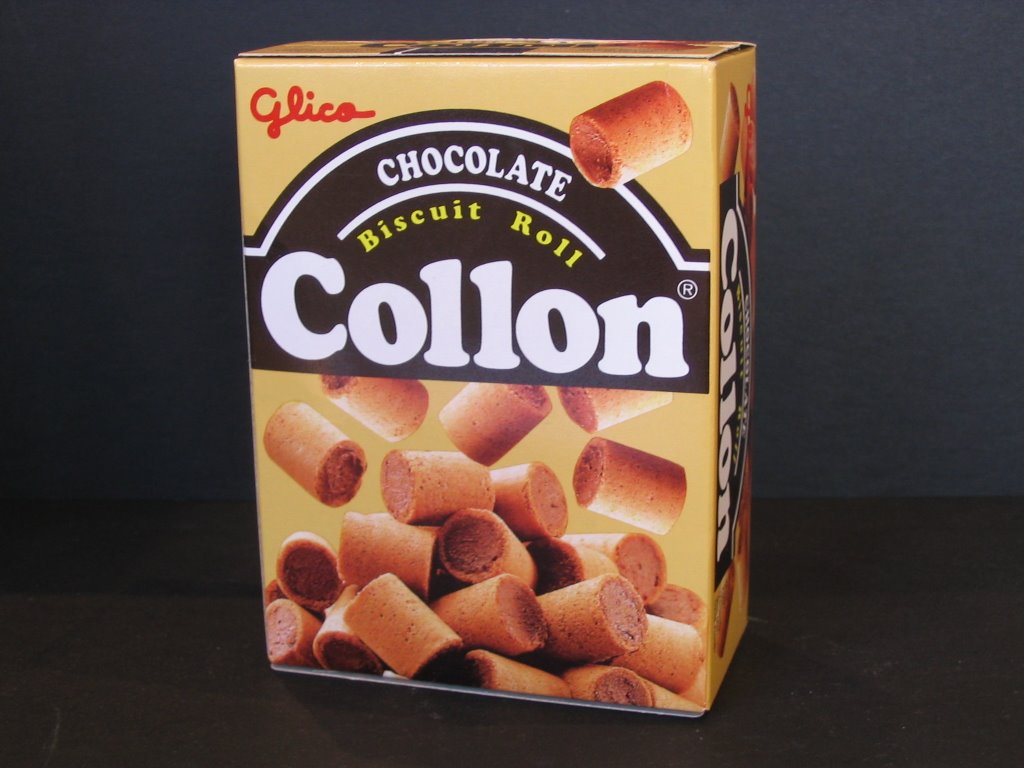
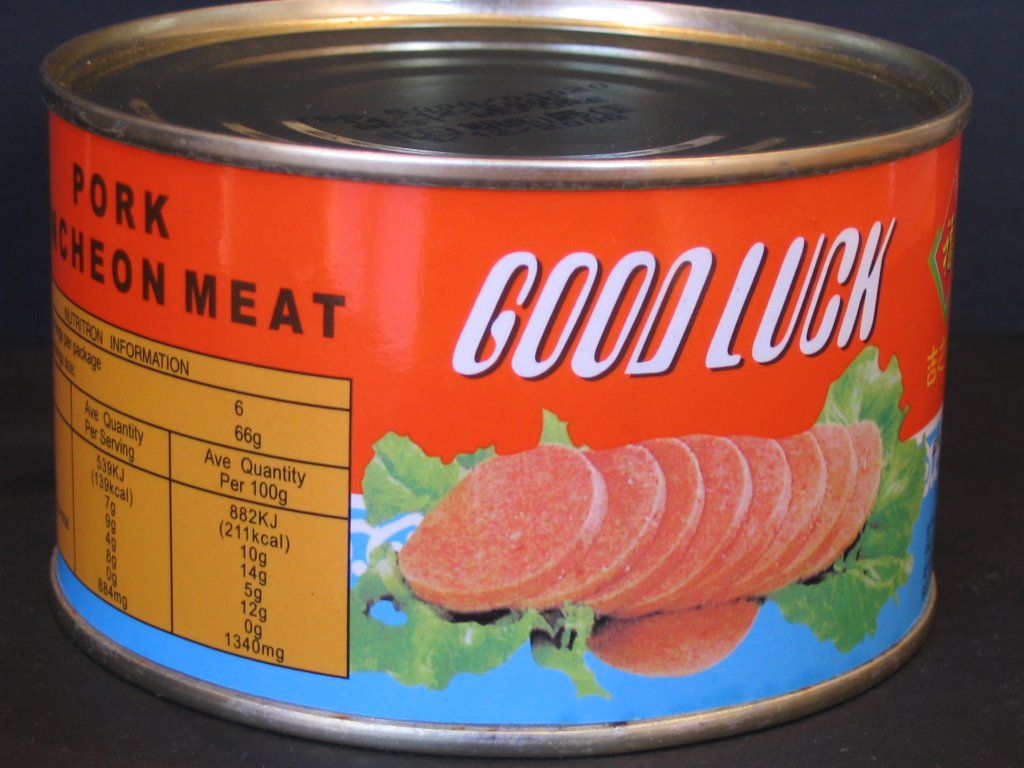
Still, it was well worth a few minutes' mental overload to find these two...


My usual advice to marketers is to avoid any connection - explicit or implied - between chocolate products and the word "colon".
And perhaps "Good Fortune" might have conveyed the intended meaning more effectively... in Australian usage, naming a canned meat product "Good Luck" sounds like a warning!

09 August 2006

Iconic landmark? I'm not having a bar of it!


It was fun being asked by The Age (put on the spot) to comment about what makes an "iconic Melbourne landmark". No, Showgirls Bar 20 isn't on my list. (By the way, the link is for those unaware of Bar 20 and in no way an endorsement, and yes, I had to go looking for it!)

In this case, "iconic Melbourne landmark" is, of course, just another expression from the real estate agents' lexicon (from the people who brought you "renovator's delight" and, in Sydney, "Harbour glimpses"). But it does prompt the interesting question of what makes for an icon, especially from a branding perspective.

"Icon" is generally used as a cultural term: to be regarded as an icon, a brand really needs to be linked to, and to symbolise, something that's culturally important. (For more on this, see the book How Brands Become Icons by Douglas B. Holt.)

But important to which culture? Our "national" culture? I don't believe we have a single national culture, so I'm generally very suspicious when anyone claims something like "mateship" as an inherently Australian cultural value (see Don Watson's excellent critique of the politicisation of mateship - he asks whether it isn't in fact gender-biased and xenophobic, and why John Howard seems so keen on promoting it).

I would, however, agree that the MCG is an iconic Melbourne landmark. It's very widely recognised and has enormous cultural relevance and resonance for a very broad cross-section of Australians. It calls to mind significant sporting and cultural events - not only the 1956 Olympics, 2006 Commonwealth Games, VFL/AFL football, Test cricket, soccer, rugby, etc., and great sporting achievements, many of which are themselves symbolic of cultural values. But there are all the other events and uses, too: military (First World War conscription rallies, a base for RAAF personnel and US Marines in the Second World War), spiritual (from evangelist Billy Graham to Pope John Paul II), artistic (concerts by David Bowie, David Cassidy, Madonna, U2, Michael Jackson, the Rolling Stones), and Royal... along with thousands of other schoolkids, I saw the Queen from the "hallowed turf" of the MCG on her 1970 Royal Tour. We were arranged into large herds, and Her Majesty was driven around us in a kind of Queen-mobile. Apparently, this was deemed culturally and educationally important enough at the time to take us out of school for the day, but it seems pretty bizarre 35 years on!

Likewise, Flinders Street Station is an iconic landmark. It has great symbolic value to the many generations of Melbournians, from all kinds of cultural backgrounds, who've arranged to meet "under the clocks" and is well and truly linked to notions of what it means to live here for most Melburnians.

So I'm not being a prude or a wowser (a tremendously useful and culturally-laden word that seems to have faded from use lately) when rejecting Bar 20 for icon-ification. It's not that a venue for adult entertainment and "showgirls" can't be an icon - I would certainly support icon status for the Folies Bergère or the Moulin Rouge in Paris. And I'm certainly prepared to acknowledge that many Melburnians have probably had a good time at Showgirls Bar 20, recognise it and perhaps even think fondly of it. But I'm afraid I just don't think it can really lay claim to symbolising any cultural truths about life in Melbourne for significant groups of our citizens.

Of course, I'd love to hear from anyone who thinks I'm not paying Bar 20 its due cultural respects - comments always welcome.

28 July 2006

Comments on my piece on regulating drug promotion

I thank Dr Ken Harvey very much for his comments, which you can read here (I haven't been able to figure out how to get Blogger to post comments with the original). I would also urge readers to follow some of the links Ken has provided and check out the evidence for themslves.

If you read my piece carefully, I don't actually argue that doctors are not influenced by the promotional activities of pharmaceutical companies. Of course, they are also influenced by their cultural backgrounds and religious beliefs, what medical school they went to, their patients, what they read in the newspapers as well as in the medical journals, what their colleagues tell them in the tea-room (evidence-based or not!), and whether they had time for breakfast and have had that all-important first cup of coffee yet (sponsored or not!). But I don't hear people clamouring for the ACCC to investigate the effects of each of these - and their interactive effects - on prescribing behaviour.

In the course of interviewing hundreds of GPs and specialists about influences on their clinical decision-making, I have been utterly flabbergasted at some prescribing practices that clearly owe nothing to company promotion (let alone any sort of logic). Of course doctors deny that they are influenced by promotion - from Federal Court judges and competition commissioners to mug punters at the local TAB, we all like to think of ourselves as rational decision-makers, but it's just not the case. But I've seen numerous product managers squirm when they hear the news that doctors can't recall the quirky brand name, thought it was only approved for a different indication, still prescribe the old one out of habit, etc. etc.

Anyway, I don't argue that there is no influence. But I will continue to argue most strenuously with those who make a giant non sequitur, leaping from the question of influence to the conclusion that this harms patients or community health or welfare. For example, the ACA says sales reps should be externally regulated because “representatives attempt to influence doctors’ prescribing patterns in non-rational ways which have negative outcomes for consumers”. This single, unreferenced, sentence paints the sales rep as deceptive, the doctor as potentially irrational and the consumer as unwitting victim. The Medicines Australia code mandates reference support for claims about drugs, but there is clearly no such code for the ideologue!

And speaking of influence, consider some of the incredibly emotive language used by Graeme Samuel in his opinion piece in today's Melbourne Age. At first, he reserves judgement and concentrates on transparency: "Regardless of whether such largesse actually influences a doctor or not... the perception of influence is enough". But, just when we think he's keeping an open mind, CLANG! the cell door closes: "Doctors prescribing medication based on anything other than the patient's needs offends the morals" and these are "grubby issues" and "an unpleasant stain" (presumably the remains of one of the "lavish dinners" at "top-class restaurants"). In other words, we’re not saying it happens, but it’s disgusting and we’re going to act anyway!

Finally, while we're on the subject of the difference between rational and emotional persuasive appeals, both Ken Harvey and the ACA played "the tobacco card" in their submissions to the ACCC. The ACA actually said "a parallel can be drawn between the methods employed by the pharmaceutical industry now and those that were employed by the tobacco industry" - you can read this outrageous quote for yourself here.

27 July 2006

ACCC prescribes castor oil for greedy doctors

Doctors – supposedly the “victims” of the pharmaceutical industry's promotional excesses and "sophisticated" persuasive techniques – will be the biggest losers under new requirements of the Australian Competition and Consumer Commission (ACCC) for greater levels of disclosure and transparency in relation to pharmaceutical company sponsorship, announced yesterday. (The ACCC authorises the industry self-regulatory code developed and administered by Medicines Australia.)

In fact, pharmaceutical marketers may actually benefit from closer public and regulatory scrutiny of their spending on entertainment for doctors, but doctors will be further disadvantaged if sponsorship of prescriber education is reduced as a consequence. But the bottom line is that the changes are likely to have no discernible effect on the health and welfare of consumers and the community as a whole.

There have certainly been some excesses in terms of pharmaceutical entertainment and largesse in the past... and I've been to some fairly lavish affairs put on by drug companies (and usually wound up asking myself why they were bothering). But, from a marketing perspective, many promotional practices viewed in the pharmaceutical industry as ‘the usual’ or ‘cost of entry’ are actually undertaken without any evidence of their marketing effectiveness.

Just because companies do something doesn’t mean it works... or, indeed, that it is harmful to the health of individuals or the community. Many of those urging the ACCC to impose tighter controls on the activities of pharmaceutical companies don’t cite any evidence that promotion actually has harmful effects on the attitudes or behaviour of prescribers.

In many cases, it's possible that cutting back on largesse might actually enhance pharmaceutical company profitability by reducing wastage. Drug companies should be ensuring that they invest their marketing dollars where they will be most effective. In the spirit of value-based marketing, the industry should probably look at this new requirement for transparency as an opportunity – it may well force greater internal scrutiny and justification of some of the "traditional" lines on their marketing and promotional budgets.

But the whole issue of further regulation leaves a bitter taste for doctors. Firstly, any increase in scrutiny inevitably raises implications about the perceived intelligence and integrity of prescribers. This type of regulation sends an unequivocal signal to the community that the ACCC feels doctors cannot be trusted to evaluate clinical and scientific evidence for themselves or, at worst, to behave ethically when selecting treatments.

The underlying message is that the regulator we trust to protect us as consumers – egged on by lobbyists such as the Australian Consumers Association (ACA) – believes that a doctor might put his or her own interests ahead of those of the patient for the price of a restaurant meal and half a bottle of wine. If you think I'm being melodramatic, check this out... In a submission to the ACCC, Prof Ken Harvey of La Trobe University argues for tougher regulation of pharmaceutical promotion not on the basis of evidence but on the astonishing assertion that pharmaceuticals are like tobacco and alcohol, and that any “highly profitable industries which spends (sic) a large proportion of their earnings on sophisticated promotion all encourage overconsumption and unhealthy habits”.

Secondly, prescribers are still expected to act as agents and "gatekeepers" for the Government in administering the Pharmaceutical Benefits Scheme (PBS), a role for which they are completely unremunerated, while what minor compensations there might be for undertaking this role are whittled away.

The PBS is a massive program under which Australian consumers get extraordinary access to the world’s best and latest drugs. Yet doctors are expected to spend their own time and resources keeping themselves up to date with the intricacies and fine print of PBS listings, which change every three months. Even the most strident advocates of centralised regulation of pharmaceutical promotion acknowledge the reality that doctors remain reliant on the pharmaceutical industry for information about new drugs and changes to PBS listings and requirements.

QBrand's own experience conducting research with hundreds of GPs and specialists confirms that doctors take this gatekeeping role extremely seriously if grudgingly. Yet in no other sector of Australian society would professionals be expected to fulfil such an agency role without some form of consideration or compensation... like the occasional dinner and a drink!

25 July 2006

Naming rights: If you can't lick 'em...


We're pretty accustomed now to various stadiums, events and sporting teams carrying sponsors' names. There's Colonial Stadium, now the Telstra Dome; the Marlboro/Ford/Kia Australian Open tennis; the Foster's/Emirates Melbourne Cup (and even the year when - horror of horrors - Toohey's New, a beer from north of the border, had the naming rights). The Collingwood Football Club is now based at the Lexus Centre - no longer Victoria Park. And in the recent World Cup (Germany 2006), we even had the Qantas Socceroos.

But what about naming rights to public spaces? I was surprised recently to find that one feature of Brisbane's very attractive Southbank recreation precinct is an appealing (if artificial) kids' swimming area (pictured here) with a white sandy foreshore and even its own lifeguards... for which naming rights have been sold. Yes, the signs, banners, etc. proclaim that it is Streets Beach (Streets as in the Unilever ice cream brand - the Australian equivalent of Good Humor, for readers in some other markets).

If it's OK - in the name of philanthropy - for commercial interests to sponsor galleries, or to endow chairs at universities, then why was my initial reaction to Streets Beach one of some discomfort?

Perhaps it's just an emotional response to Unilever's relatively blatant, undisguised intent to link an indulgent product so obviously targeted towards children to a public activity and resource provided for children. On the other hand, on a purely rational basis, I can't really see why this should be any more objectionable than linking a cultural institution like the Melbourne Cup to a beer brand.

And I guess if I were marketing manager for Streets, it might have seemed like an attractive opportunity. As ever, though, I'd be very interested to look at the return on investment. In my experience, even the largest corporations seldom measure the real effects and cost-benefit of this type of sponsorship with any degree of spohistication.

Which bank creeps out its customers?

Number 3 in a series reporting bizarre customer service encounters at my local branch:

Back in March this year, the Commonwealth Bank announced a "new strategic direction focussed on customer service". What I'm seeing at my branch, however, appear to be some very un-focussed and, frankly, downright weird manifestations of that strategy.

I went to bank a cheque the other day. When the teller brought up my account details on screen (where I couldn't see them), he peered at them then smiled at me and asked: "How's your home loan?". Perhaps this was simply meant to be a friendly enquiry or, more likely, a clumsy introduction to some kind of "up-sell" (e.g. "Can I make an appointment for you to talk to one of our lending advisers?"), but I found it disquieting. It's like going to the doctor with a cold and having him/her look you up and down and ask "How's your liver?". My natural reaction: Why are you asking? Do you know something I don't? Have I turned yellow since I last looked in the mirror? etc.

Am I just being paranoid? I don't think so. I actually appreciate "Do you want fries with that?" customer service scripts when they are contextually appropriate! Unfortunately, when the context and delivery are inappropriate, the effect is invasive and creepy. Another example of the Commonwealth stalking its own customers!

28 June 2006

The bus stops here... but the bucks go to JCDecaux

Outdoor advertising used to be seen by many people as a blight on the visual landscape of our cities and suburbs. But, just as authorised graffiti becomes "street art", outdoor advertising takes on a new respectability when it is "street furniture".

JCDecaux, global leaders in "street furniture" (who claim to work in partnership with more than 3500 town and city auhorities in 45 different countries), are signing contracts with more and more Australian municipal councils and transport authorities to build and maintain bus shelters, phone booths and the like in exchange for advertising placement rights on that furniture... and hence in our city streets and public landscapes. This is a somewhat different situation from the old days where a building owner sold space on his outside wall for a billboard, or a farmer allowed a "Golden Fleece Roadhouse, 5 miles" sign in the paddock by the highway.

How does JCDecaux choose sites for this "street furniture"? You might expect that public resources provided on public land under the terms of a contract with a public authority would be located where they will best serve the public. However, the evidence suggests otherwise, namely that the key advertising principle of exposure ranks significantly higher on the JCDecaux priority list than does any analysis of public utility.

As the company notes on its Australian website (under "Why JCDecaux"), "...we invest only (my emphasis) where high volume, high quality audiences are assured". Their Citylights advertising panels (the name they give to their bus and tram shelter sites) "...are a (sic) specially developed network to reach (sic) higher volumes of audience (sic) and higher income earners with disposable incomes (sic)". [Note: The appalling lack of copywriting skill on the JCDecaux website has made me "sic" all over the place!]

That's hardly surprising for an outdoor advertising company, after all. Yet some local councils seem to be trying to have their ratepayers believe that JCDecaux is providing these resources out of pure public-spiritedness. When push comes to shove, of course JCDecaux will put commercial consderations first.

South Sydney Council's arrangements with JCDecaux in the late 1990s apparently led to the unilateral relocation of bus shelters without community consultation (as noted by then NSW Parliamentarian Clover Moore, now Sydney's Lord Mayor)

The Pedestrian Council of Australia has noted that "in many cases, JC Decaux has placed... scrolling billboards directly in front of pedestrian crossings at some of the busiest intersections in the CBD", warning of their "propensity to distract drivers from watching the road and the traffic lights".

And my own experience suggests that when Councils take a laissez faire attitude to the French company's approach to the placement of advertising - sorry, street furniture - the outcomes can actually diminish public utility and cause public nuisance. Banyule City Council, which takes in the well-to-do Melbourne suburbs of Ivanhoe and Eaglemont as well as socioeconomically disadvantaged and refugee communities in West Heidelberg, announced in July 2005 that it had awarded a 15-year contract to JCDecaux "to supply, install and maintain 119 bus shelters and associated rubbish bins on main arterial and local roads throughout the municipality". The first of these of which I became aware was installed in a position where the large advertising poster on the end of the shelter completely obscured the vision of drivers attempting to make a right turn into a notorious stretch of one of these arterial roads... where it was odds-on to cause arterial bleeding!

Banyule Council received numerous calls from concerned residents even as the JCDecaux tradies were finishing the installation - nothing to do with the advertising, merely the lethality of its placement. The poster was replaced with clear glass, but this doesn't mean the same thing isn't happening at numerous other locations around the country.

And while (as per the press release) the local Councillors staged their launch photo opportunity at a new shelter in in West Heidelberg's "Mall", you can rest assured that JCDecaux will have done its sums in planning its Banyule bus shelter portfolio: a few freebies in areas like the Olympic Village are more than made up for by the fees recouped from selling ad space in other "high volume" sites with "high quality audiences".

14 June 2006

Update: Nestlé acquires Uncle Tobys

The RMIT University press release re my thoughts on the acquisition of Uncle Tobys by Nestlé, as discussed on this blog on 24 May 2006, can be found here.

11 June 2006

A Tiid-ious campaign from Nissan


If you've watched Australian TV at all this year, you couldn't help knowing that Nissan has launched the Tiida, its small-car replacement for the Pulsar. Now, I may not be in the target demographic (said to be 30-something, female skew), but when it comes to the ad campaign, I reckon the name Tiida must be short for "tired idea". When Harry Met Sally, which featured Meg Ryan's fake orgasm scene, was made in 1989. How many times since then has the "I'll have what she's having" idea been used in advertising? Definitely for shampoo, and I think I also recall a breakfast cereal version. Anyway, as a creative idea, "product induces orgasm" is, like a 1989 Nissan Pulsar (pictured), unlikely to turn many heads or win many awards in 2006.

OK, so there are plenty of lame ads around. The reason why I really take exception to this one has much more to do with what we might call the "Trapper John, MD effect". There is something unpleasant and disheartening about the exploitation of a well-loved character from a TV show, especially when it is done in a way that is unimaginative, predictable and very unfunny.

Consumers and TV viewers can tell the difference between actors and their characters. We know it's Sarah Jessica Parker, not Sex and The City's Carrie Bradshaw, who advertises Garnier Nutrisse. But the person in the Nissan Tiida ad is clearly the character Samantha Jones, not the actor Kim Cattrall.

I want (and feel I have the right) to remember the women of Sex and The City as they were written by Darren Star and Michael Patrick King, and as we left them at the end of Season 6 in 2004*. If they are to have a life after Sex, then let Darren Star decide that - I don't want my fond memories of a landmark TV show to be sullied in any way by some Australian copywriter's idea of how "Sam" might enjoy a ride in a small Japanese car. Even if it was developed by an all-female creative team at Whybin TBWA, and they happen to be the world's biggest fans of Sex and The City, that's no excuse in my book (in fact, if they claim to be fans, that gives them even less excuse!).

*Just a reminder... in the final epsiode we left Samantha Jones in her most committed relationship yet (with Smith) and fighting breast cancer.

01 June 2006

The shape I'm in(to)


The body of a Gibson Les Paul. The headstock of a Fender Stratocaster or Telecaster. A bottle of Grant's Scotch or a Crown Lager. A Weis Mango and Cream ice cream bar. The cap of a Bic ballpoint pen.

Q: What do all these have in common? A: Each is the subject of a current shape trade mark in Australia.

And I'm glad, because apart from being a few of my favourite things, the very form of each of these classic designs deserves to be protected, and not principally because they are design icons (although they undoubtedly are). Rather, their owners deserve protection against imitators because of the effects of shape on consumers. A distinctive shape doesn't only identify a product to a consumer as being from a particular source; shape is also a highly salient (easily processed) cue to retrieval by the consumer of the network of associations in memory that actually constitutes the brand in his or her mind.

So when I see a guitar that's the shape of a Gibson Les Paul, I don't only identify it as a product from the Gibson Guitar Corporation. It calls to mind a distinctive sound, several genres of 70s rock that I associate with the guitar and its sound, songs and styles that sound better on a Les Paul, and even particular players (see Wikipedia's entry here for a far-from-comprehensive list). These recollections are also linked in my mind to quality assessments, judgments and emotional associations.

The shapes of a Coca-Cola bottle, the triangular prismatic packaging of Toblerone chocolate or a Turbuhaler asthma inhaler (also protected as shape trade marks) all tap into similar rich networks of brand associations... even if I don't know exactly who makes the products or owns the trade marks. In other words, while a shape trade mark is based on the idea of a shape being an indicator of origin, it may protect things that are a whole lot more valuable to a marketer than mere source identification.

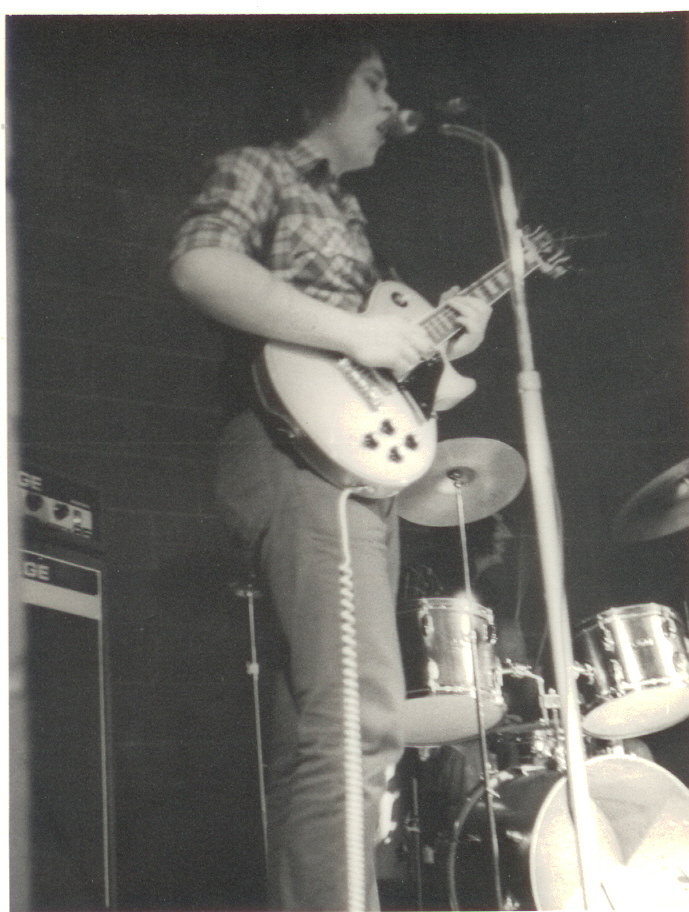
Oh, and if you're wondering about the picture... it's yours truly about 30 years ago (but who's counting?) playing an unmistakeably shaped Gibson Les Paul. (In fact, it's a Les Paul copy (!) by Ibanez, one of the companies Gibson has sued in an attempt to protect the value of that very iconic shape. What teenager could afford a real Les Paul?) Makes me wish I had been able to protect my shape (apart from the Miller shirt, perhaps)!

24 May 2006

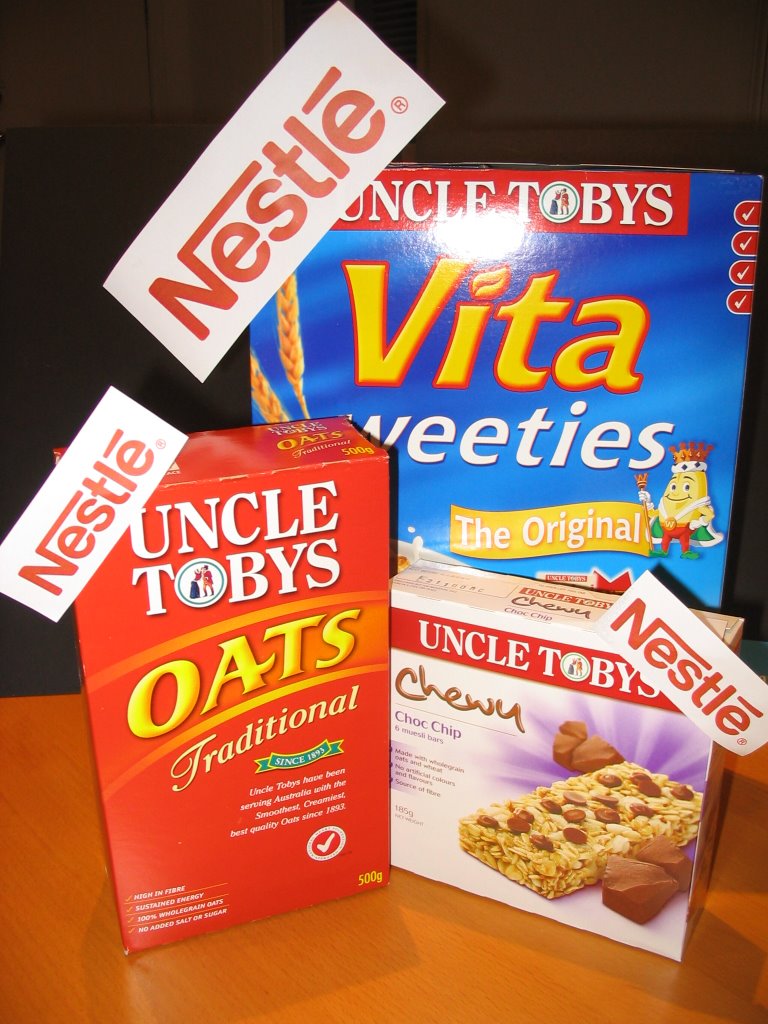
Will a Nestlé-owned Uncle Tobys give Aussie consumers the Vita Brits?


I was interviewed today by Derryn Hinch about how consumers might react to the purchase of Uncle Tobys by Nestlé (in partnership with General Mills for the breakfast cereals). The short answer (as always) is that it depends...! Some may be concerned and react unfavourably to the acquisition of this "iconic" Australian brand by a global giant like Nestlé. This might even lead those consumers to avoid buying Uncle Tobys products. At the other end of the consumer spectrum, many just won't notice or care about a change of ownership, especially if there is no discernible change to the products that appear under the Uncle Tobys name.

Between these two extremes, the reaction of the majority of Australian consumers will depend on how aggressive Nestle is in "Nestlé-ising" the Uncle Tobys brand and/or trying to reposition it.

Uncle Tobys has long emphasised its Australian-ness, e.g. through its involvement with sports such as surf lifesaving and in many of its advertising and packaging images. Consumer perceptions of Nestlé as a large multinational or global firm with many different product lines and areas of operation could conflict with current perceptions of Uncle Toby's as a small(er) Australian company making Australian products (notwithstanding the fact that it has been New Zealand-owned for some time... close enough?), giving consumers less reason to prefer Uncle Tobys products over competing brands.

Uncle Tobys brand positioning is also built around the idea of "wholesome" breakfast and snack foods based on cereals and fruit. By contrast, Nestlé is perhaps better known to Australian consumers for convenience and indulgence products like Milky Bar, Kit Kat, Aero, Nesquik, Milo, as well as Nestle Peters icecream brands like Heaven. This might also create conflicting or negative brand associations for a Nestlé Uncle Toby's or Uncle Toby's by Nestlé brand, especially among parents concerned about their children's nutrition and childhood obesity.

I have no wish to fan the flames, but it should be noted that Nestlé has long been the subject of an international boycott by a small but vocal group of consumers who hold that Nestlé has acted and continues to act unethically in its marketing of infant formula in the third world. While this began as long ago as the 1970s, it is an association with the Nestlé brand that still surfaces in consumer focus groups today. For some Australian consumers, this alone will be enough reason for them to stop them buying Uncle Tobys products immediately.

Just how obviously and rapidly Nestlé will communicate its ownership of Uncle Tobys in advertising and product packaging remains to be seen, as there are some contradictory precedents. Nestlé has prominently re-branded Peters ice cream ("The health food of a nation") as Nestlé Peters, and what were once Rowntree confectionery brands are now Nestlé Kit Kat and Nestlé Aero respectively. The Nestlé products that already compete with Uncle Tobys in the breakfast cereal category - Nesquik, Milo and Cheerios cereals - are also very prominently Nestlé branded. On the other hand, Nestlé has (so far) let the Life Savers brand stand alone, and you won't find the familiar Nestlé logo on a pack of Purina Lucky Dog!

In summary, I would advise Nestlé to go very gently on the corporate (Nestlé) branding of Uncle Tobys, at least until they have done some thorough consumer research to establish what negatives might be associated with the change of ownership. It's a significant investment: Nestlé has paid about 11.5 times the 2005 earnings of Uncle Toby's, reflecting a very high valuation for the goodwill and potential of the Uncle Toby's brand. But whether it's brand extension or brand acquisition, the relationship between one brand and another is always a two-way street. It's possible, in a worst-case scenario, that negative consumer reaction to the acquisition could render the Uncle Tobys brand LESS valuable in the hands of Nestlé than it was under Burns Philp's ownership.

15 May 2006

Marketers: Here's why the Trade Mark system Bites

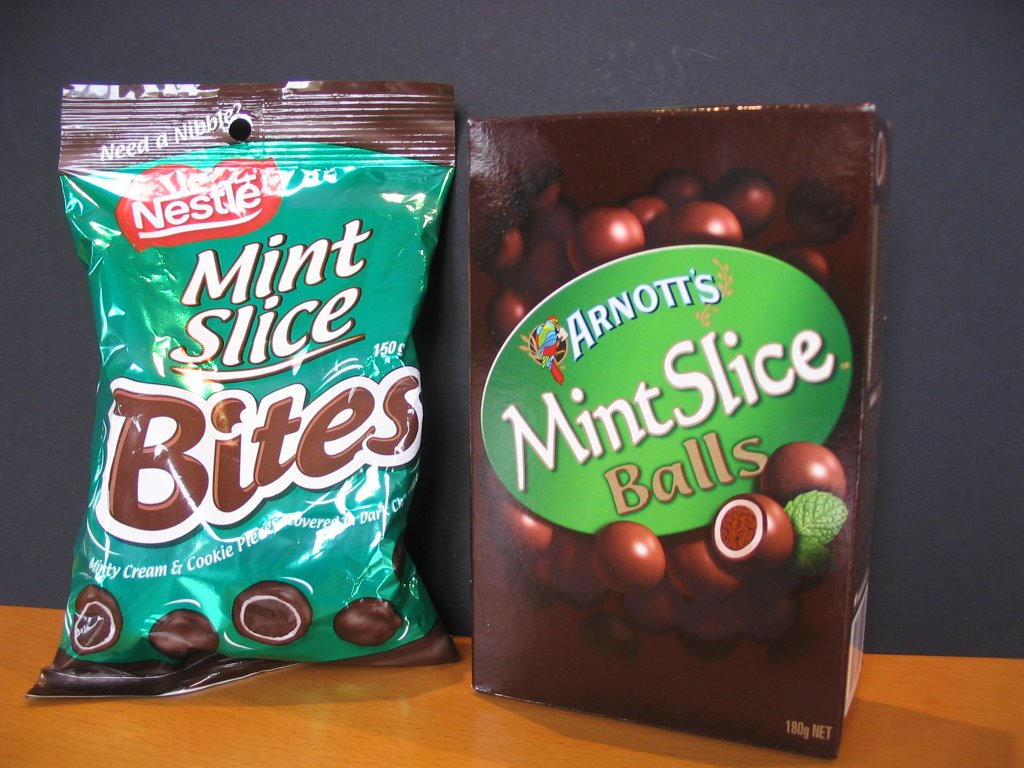
Only a fool would argue that Arnott's does not have brand equity in the name "Mint Slice", one of its well-known chocolate biscuits. The faith of Arnott's and FMCG giant Unilever in the value of this equity has recently been demonstrated through a co-branding arrangement between the two firms: Streets Blue Ribbon Mint Slice tub ice-cream and then the Streets Cornetto Arnott’s Mint Slice (quite a mouthful). More recently, Arnott's has itself moved closer to the confectionery category with its Mint Slice Balls brand extension (as pictured on the right)

Yet it may surprise you to know that Arnott's does not have a Trade Mark for the words "Mint Slice". Registration of the mark was refused by a Hearing Officer of the Australian Trade Marks Office (now IP Australia) in June 1998. You can download the decision as a PDF here. In summary, the officer found that the words "mint slice" were not capable of distinguishing the applicant’s (Arnott's) goods. Obviously they didn't ask members of my family... when my wife and daughter (both self-confessed chocaholics) hear the words "mint slice", they immediately and unequivocally call to mind goods from a particular source, namely Arnott's.

It turns out that Arnott's had in fact conducted and submitted a survey of 1200 Australian consumers which found: (1) 69% of people who said they were familiar with Mint Slice recognised Arnott's as the manufacturer; and (2) of those who were aware of Mint Slice and said they knew which company manufactured it, 91% named Arnott's.

Pretty convincing, you might think? Apparently not to the the Hearing Officer, who seemed more concerned with the 7% of respondents who associated the product with two manufacturers other than Arnott's, and rejected the (very plausible, in my view) explanation that these respondents had done so in error, or were simply guessing.

As a result, Arnott's has no claim under the Trade Marks Act to prevent competitors like Nestlé from using the words "Mint Slice" on its "Mint Slice Bites". Interestingly, Nestlé even uses the words "Mint Slice" on the packaging in the same manner as it uses the brand names "Kit Kat" and "Violet Crumble" on other products in its "Bites" range.

So, Arnott's has strong brand awareness for "Mint Slice" - more than enough to convince Unilever of the benefits of co-branding (it has done the same with another famous Arnott's brand, "Tim Tam") - but can't prevent others from hijacking that equity.

This is another powerful demonstration of the disconnect between the Trade Marks system and the realities of marketing and consumer response. However, it's also a salutory lesson in the difficulties you are likely to face if (under the current Trade Marks system) you choose to build a brand around a name that could be construed as "descriptive", as discussed on this blog a few weeks ago.

14 May 2006

Customers wanted: Dead or alive!


Were you one of the 150,000 "community leaders" who were mailed - in an envelope marked "private and confidential" - an "exclusive invitation" to the opening of the Commonwealth Games from Games supremo Ron Walker himself? Of course, as was well covered in the media at the time, a very wide variety of Victorians received them, including my wife and her Pilates teacher, but not me (do I sound bitter?), and at least 40 people who were no longer leading the community but rather some kind of heavenly choir. That's right, even dead people were being sought to liven up the Opening Ceremony. This was widely perceived as a desperate response by Ron and his team to low ticket sales - here's how The Age reported it. The term "community leaders" sounds like direct marketing (DM) industry code for high income earners, but there were plenty of pensioners... and, of course, not many people continue to earn income posthumously, notable exceptions being Elvis, John Lennon, etc.

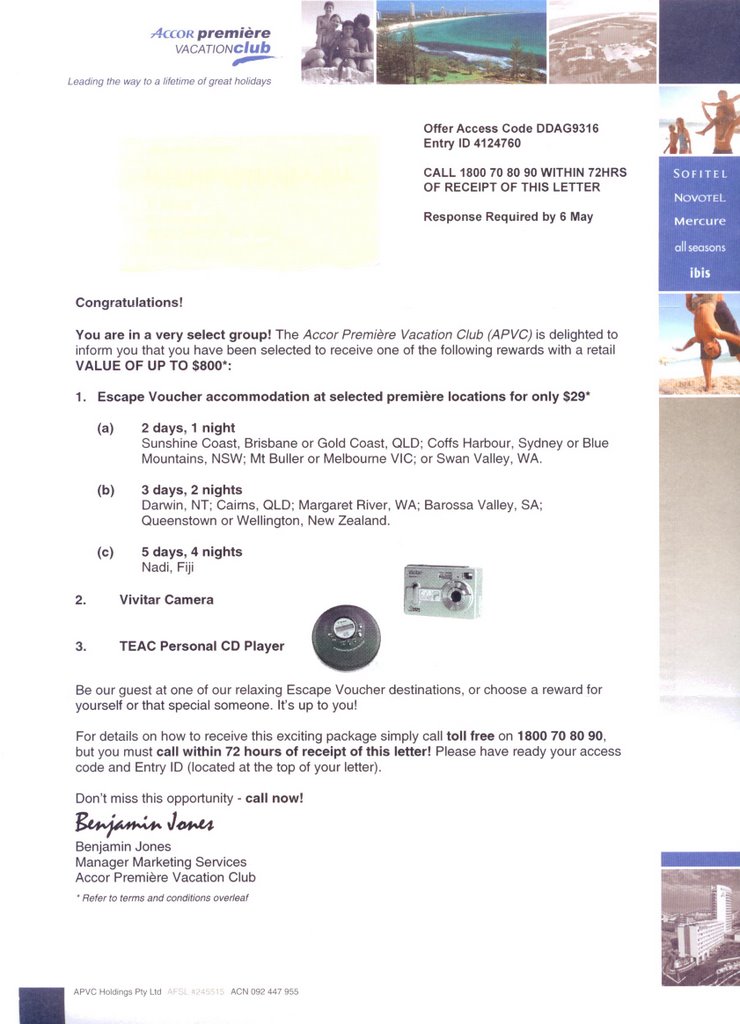
Now the Accor hotels group - owner of the Sofitel, Novotel, Mercure, Ibis and Formule 1 accommodation brands - has taken a leaf out of the Ron Walker marketing manual. My late father-in-law Ernie, who passed away early in 1998 (yep, that's more than 8 years ago) has just received an exciting mailing from the Accor Première Vacation Club, a "holiday ownership" scheme (the sort of thing that used to be called "timeshare") that is a joint venture between Accor and the property developer Becton.

According to the letter from a Mr Benjamin Jones, Ernie is in a "very select group" and was "selected" to receive a "reward" with a retail value of up to $800, the only catch being (what, you didn't realise there would be one?) that he would be required to sit through a lengthy sales pitch (sorry, a 90-minute "holiday ownership preview") and doubtless be subjected to significant pressure to sign up or make some other commitment before taking up his "reward".

So just how bad is Accor's mailing list? The "Frequently Asked Questions" section on the reverse of the letter says "You are one of the select few able to take part in this promotion. You have been chosen to receive this special offer based on certain demographics, past promotions or personal buying habits". The reality: Ernie has (of course) not travelled anywhere, bought anything, responded to a promotion or used a credit card in eight years, so the "selection" process certainly isn't based on any recent market activity or response. What about "demographics"? Well, if Ernie were still alive, he would be aged 81 - definitely not a prime candidate to invest in timeshare!

In fact, based on the way in which the letter was addressed, it is clear that the only way Accor's DM people specially "selected" Ernie to receive this "exciting package" is by using the White Pages. Yes, he's still in the phone book and that's where Accor has gone trawling.

Receiving mail for a departed loved one can be distressing, but I prefer to look at it this way: next time I receive a personally addressed "special offer" and I'm tempted to feel flattered that some company has identified me as a highly desirable customer, instead I'll simply think fondly of Ernie, and smile as I am reminded (as if I needed to be) of just how abysmally poor so much direct marketing has become.

By the way, while Accor is a French company, Becton is ASX-listed with Australian shareholders. If I owned Becton shares, I would be livid at this example of a marketing practice that is dumb, ham-fisted, "bottom-feeding" and wasteful, when I expect modern marketing strategies to be based on shareholder value. How much of Becton's potential profits and dividends are being used to send unsolicited, misleading and untruthful material to unqualified prospects with zero chance of response?